RO4350B is a glass-reinforced hydrocarbon/ceramic thermoset laminate used in RF and microwave printed circuit boards. It is not a PTFE laminate. The material combines controlled electrical properties with processing methods familiar to many FR-4 fabricators.
What to decide before release
Use the material designation as only the first line of a fabrication specification. A usable stackup also names dielectric thickness, copper foil, finished copper, bonding material and surface finish. Two boards sold as RO4350B can have very different RF performance because their geometry and processes differ.
Checks to put in your design brief
- Identify the exact core and foil
- Ask the fabricator for an approved stackup
- Confirm the RF performance with a coupon or prototype
Important distinction
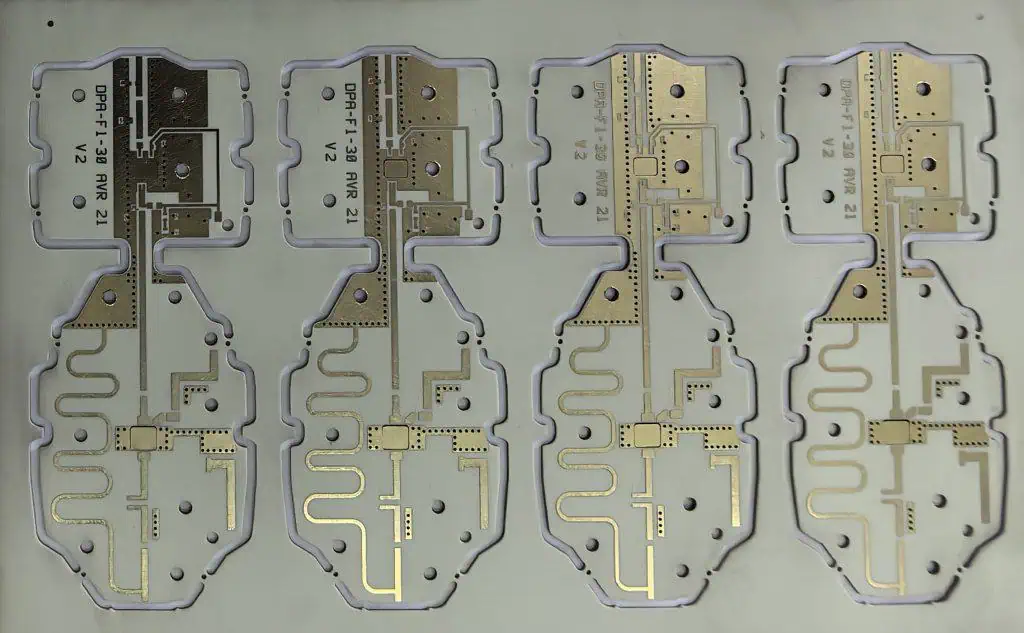
A photograph can show an RF construction but cannot authenticate the laminate grade. Keep material certificates and lot traceability with the build record.
| Property | Value | Measurement basis |
|---|---|---|
| Process dielectric constant | 3.48 ± 0.05 | 10 GHz, 23°C; clamped stripline |
| Design dielectric constant | 3.66 | 8–40 GHz; differential phase length |
| Dissipation factor | 0.0037 | 10 GHz, 23°C; typical |
| Dissipation factor | 0.0031 | 2.5 GHz, 23°C; typical |
| Glass transition temperature | >280°C | TMA; not a continuous-use rating |
| Decomposition temperature | 390°C | TGA; not a reflow setting |
| Thermal conductivity | 0.69 W/(m·K) | 80°C; typical |
| CTE, X / Y / Z | 10 / 12 / 32 ppm/°C | −55 to 288°C |
| Moisture absorption | 0.06% | 48 h, 50°C immersion; 0.060-inch sample |
| Density | 1.86 g/cm³ | 23°C |
| Copper peel strength | 0.88 N/mm | 1 oz ED foil; after solder float |
| Flammability | UL 94 V-0 | Standard laminate; verify exact construction |
The 4 mil core has a separate process-Dk value of 3.33 ±0.05. Typical values are not procurement limits. Read conditions and exceptions.
Sources & basis
Material facts follow the cited source. Design checks are preliminary guidance, not supplier process instructions.